Chapter 6.4. Unsafe Code Verification
Unsafe code enables low-level operations while circumventing Rust’s safety guarantees, and may introduce undefined behavior (UB) if misused. This module presents an approach for verifying the soundness of unsafe code usage.
Our approach is based on the following assumptions:
- Origin of Unsafe Code: All instances of undefined behavior arise from unsafe code.
- Well-Documented Safety Properties: All safety properties of unsafe code must be explicitly documented, including safety conditions for unsafe functions, invariants for structs, and requirements for safely implementing unsafe traits.See this document for more details.
- Soundness of Unsafe Code Usage: Unsafe code is considered safe if all possible executions satisfy the safety properties of the underlying unsafe operations.
There are two basic steps in verification:
- Identify verification targets: Given a Rust crate, identify the targets that need verification.
- Verify safety properties: For each target, verify that it is sound.
In the following discussion, we use Challenge 17: Verify the safety of slice functions as a running example. This challenge involves several methods on Rust slices.
6.4.1 Identify Verification Targets
In our approach, each verification target is a function. However, not all functions require verification.
Free Functions: A free function is considered a verification target if it contains internal unsafe code, regardless of whether it is declared as unsafe.
The verification objective is to ensure that all unsafe callee’s safety contracts are satisfied under the caller’s safety contracts:
$$SC_{\text{caller}} \cup \text{caller} \models SC_{\text{callee}}$$
Associated Functions: An associated function is considered a verification target if any of the following conditions hold:
- it contains internal
unsafecode; - its associated struct defines type invariants;
- it is part of an
unsafetrait.
For the first two types of associated functions, if the verification target is a constructor, the verification obejctive is to ensure that: $$SC_{\text{caller}} \cup \text{caller} \models SC_{\text{callee}} \cup SC_{\text{type}}$$
Otherwise, the verification obejctive is to ensure that: $$SC_{\text{type}} \cup SC_{\text{caller}} \cup \text{caller} \models SC_{\text{callee}} \cup SC_{\text{type}}$$
If the target is part of an unsafe trait, the verification objective additionally requires that the trait’s safety contracts are upheld:
$$SC_{\text{type}} \cup SC_{\text{caller}} \cup \text{caller} \models SC_\text{trait}$$
The verification objectives discussed above is quite high-level. Further details can be found in A Trace-based Approach for Code Safety Analysis.
For Challenge 17, the verification targets are several unsafe methods.
#![allow(unused)]
fn main() {
impl<T> [T] {
    /// # Safety
    /// - InBound(self.ptr, index)
    pub const unsafe fn get_unchecked<I>(&self, index: I) -> &I::Output
    where
       I: [const] SliceIndex<Self>,
    {
        unsafe { &*index.get_unchecked(self) }
    }

    /// # Safety
    /// - ValidNum(N, !0)
    /// - ValidNum(self.len() % N, 0)
    pub const unsafe fn as_chunks_unchecked<const N: usize>(&self) -> &[[T; N]] {
        assert_unsafe_precondition!(
            check_language_ub,
            "slice::as_chunks_unchecked requires `N != 0` and the slice to split exactly into `N`-element chunks",
            (n: usize = N, len: usize = self.len()) => n != 0 && len.is_multiple_of(n),
        );
        let new_len = unsafe { exact_div(self.len(), N) };
        unsafe { from_raw_parts(self.as_ptr().cast(), new_len) }
    }

    /// # Safety
    /// - ValidNum(mid, [0, self.len])
    pub const unsafe fn split_at_unchecked(&self, mid: usize) -> (&[T], &[T]) {
        let len = self.len();
        let ptr = self.as_ptr();

        assert_unsafe_precondition!(
            check_library_ub,
            "slice::split_at_unchecked requires the index to be within the slice",
            (mid: usize = mid, len: usize = len) => mid <= len,
        );

        unsafe { (from_raw_parts(ptr, mid), from_raw_parts(ptr.add(mid), unchecked_sub(len, mid))) }
    }

    pub unsafe fn align_to<U>(&self) -> (&[T], &[U], &[T]) {
        if U::IS_ZST || T::IS_ZST {
            return (self, &[], &[]);
        }

        let ptr = self.as_ptr();
        let offset = unsafe { crate::ptr::align_offset(ptr, align_of::<U>()) };
        if offset > self.len() {
            (self, &[], &[])
        } else {
            let (left, rest) = self.split_at(offset);
            let (us_len, ts_len) = rest.align_to_offsets::<U>();
            // SAFETY: now `rest` is definitely aligned, so `from_raw_parts` below is okay,
            // since the caller guarantees that we can transmute `T` to `U` safely.
            unsafe {
                (
                    left,
                    from_raw_parts(rest.as_ptr() as *const U, us_len),
                    from_raw_parts(rest.as_ptr().add(rest.len() - ts_len), ts_len),
                )
            }
        }
    }

    /// # Safety
    /// - InBound(self.ptr, index)
    pub const unsafe fn get_unchecked_mut<I>(&mut self, index: I) -> &mut I::Output
    where
        I: [const] SliceIndex<Self>,
    {
        unsafe { &mut *index.get_unchecked_mut(self) }
    }

    /// # Safety
    /// - ValidNum(a, [0, self.len()))
    /// - ValidNum(b, [0, self.len()))
    pub const unsafe fn swap_unchecked(&mut self, a: usize, b: usize) {
        assert_unsafe_precondition!(
            check_library_ub,
            "slice::swap_unchecked requires that the indices are within the slice",
            (
                len: usize = self.len(),
                a: usize = a,
                b: usize = b,
            ) => a < len && b < len,
        );

        let ptr = self.as_mut_ptr();
        unsafe {
            ptr::swap(ptr.add(a), ptr.add(b));
        }
    }

    /// # Safety
    /// - ValidNum(N, !0)
    /// - ValidNum(self.len() % N, 0)
    pub const unsafe fn as_chunks_unchecked_mut<const N: usize>(&mut self) -> &mut [[T; N]] {
        assert_unsafe_precondition!(
            check_language_ub,
            "slice::as_chunks_unchecked requires `N != 0` and the slice to split exactly into `N`-element chunks",
            (n: usize = N, len: usize = self.len()) => n != 0 && len.is_multiple_of(n)
        );
        let new_len = unsafe { exact_div(self.len(), N) };
        unsafe { from_raw_parts_mut(self.as_mut_ptr().cast(), new_len) }
    }

    /// # Safety
    /// - ValidNum(mid, [0, self.len])
    pub const unsafe fn split_at_mut_unchecked(&mut self, mid: usize) -> (&mut [T], &mut [T]) {
        let len = self.len();
        let ptr = self.as_mut_ptr();

        assert_unsafe_precondition!(
            check_library_ub,
            "slice::split_at_mut_unchecked requires the index to be within the slice",
            (mid: usize = mid, len: usize = len) => mid <= len,
        );

        unsafe {
            (
                from_raw_parts_mut(ptr, mid),
                from_raw_parts_mut(ptr.add(mid), unchecked_sub(len, mid)),
            )
        }
    }

    pub unsafe fn align_to_mut<U>(&mut self) -> (&mut [T], &mut [U], &mut [T]) {
        if U::IS_ZST || T::IS_ZST {
            // handle ZSTs specially, which is – don't handle them at all.
            return (self, &mut [], &mut []);
        }

        let ptr = self.as_ptr();
        let offset = unsafe { crate::ptr::align_offset(ptr, align_of::<U>()) };
        if offset > self.len() {
            (self, &mut [], &mut [])
        } else {
            let (left, rest) = self.split_at_mut(offset);
            let (us_len, ts_len) = rest.align_to_offsets::<U>();
            let rest_len = rest.len();
            let mut_ptr = rest.as_mut_ptr();
            unsafe {
                (
                    left,
                    from_raw_parts_mut(mut_ptr as *mut U, us_len),
                    from_raw_parts_mut(mut_ptr.add(rest_len - ts_len), ts_len),
                )
            }
        }
    }

    /// # Safety
    /// - InBound(self.ptr, T, indices)
    pub unsafe fn get_disjoint_unchecked_mut<I, const N: usize>(
        &mut self,
        indices: [I; N],
    ) -> [&mut I::Output; N]
    where
        I: GetDisjointMutIndex + SliceIndex<Self>,
    {
        let slice: *mut [T] = self;
        let mut arr: MaybeUninit<[&mut I::Output; N]> = MaybeUninit::uninit();
        let arr_ptr = arr.as_mut_ptr();
        unsafe {
            for i in 0..N {
                let idx = indices.get_unchecked(i).clone();
                arr_ptr.cast::<&mut I::Output>().add(i).write(&mut *slice.get_unchecked_mut(idx));
            }
            arr.assume_init()
        }
    }
}
}
For each unsafe method, we annotate its safety properties with a contract DSL, which can be used for verification. For more details of the DSL, refer to primitive sp.
Since slice is a primitive dynamically sized type (DST), we model it explicitly as a fat pointer consisting of a data pointer and metadata.
For a mutable slice, the type invariants are:
#![allow(unused)]
fn main() {
/// ## Type invariants
/// - NonNull(ptr)
/// - Align(ptr, T)
/// - InBound(ptr, T, len)
/// - Init(ptr, T, len)
struct SliceMut<T> {
    ptr: *mut T,
    len: usize,
}
}
For an immutable slice, the type invariants are:
#![allow(unused)]
fn main() {
/// # Safety
/// ## Type invariants
/// - NonNull(ptr)
/// - Align(ptr, T)
/// - InBound(ptr, T, len)
/// - Init(ptr, T, len)
/// - ConstValue(ptr, T, len)
struct Slice<T> {
    ptr: *const T,
    len: usize,
}
}
6.4.2 Verify Safety Property
Contract Construction
Program State Modeling via Dominated Graphs
Senryx verifies safety properties through sophisticated state modeling at Rust's MIR level. The core approach tracks variable states along execution paths using a Dominated Graph (DG) data structure that captures two complementary state perspectives:
(1) All annotations preceding the unsafe code will construct the Contractual Invariant States (CIS) of the arguments;
(2) The static analyzer analyzes step by step along the MIR path and infers the Operational Trace States (OTS) based on the semantics.
To demonstrate how Senryx tracks program states and verifies safety contracts, we'll use the xor_secret_region method from Section 2 as our running example.
Safety Contract Declaration for Unsafe Target
In our verification process:
-
Safe functions undergo direct verification to ensure they properly encapsulate unsafe operations
-
Unsafe functions first require annotations of their safety requirements. These annotations will be used as fundamental invariants to verify internal unsafe callees' requirements.
For our target method xor_secret_region as example, since it is an unsafe method, we pre-examine its function body and declare:
#![allow(unused)]
fn main() {
// ValidPtr (ptr, u32, 1)
// Aligned (ptr, u32)
// Init (ptr, u32, 1)
// ValidNum (offset >= 0)
// ValidNum (self.size >= offset)
// ValidNum (offset * 4 <= isize::MAX)
// Allocated (self.buffer, u32, self.size)
// Init (region.buffer, u32, region.size)
pub unsafe fn xor_secret_region(
    &self,
    ptr: *mut u32,
    offset: isize,
) -> u32 {
    let mut src_value = ptr.read();
    let secret_ptr = self.buffer.as_ptr();
    let secret_region_ptr = secret_ptr.offset(offset);
    let secret_value = secret_region_ptr.read();
    src_value ^= secret_value;
    src_value
}
}
CIS Construction
Pre-defined annotations translate directly into CIS and serve as the foundation for subsequent state tracking.
To support more granular state binding, we introduce specialized shadow variables to represent:
- Pointer Memory: For pointer variables, we create shadow variables to track the state of the memory they reference (e.g., Var9 in the figure below, it has been re-encoded).
- Field-Sensitive: For structure fields, we extend to field-level granularity (e.g., Var1.0, Var1.1 in the figure below) to capture fine-grained state transitions.
OTS Construction
Subsequently, Senryx will perform state assignment for the variables based on the statements of MIR:
 Take
Take _5 = Vec::<u32>::as_ptr(move _6) as example, the original memory (Var1.0 pointed by Var6) has the Allocated and Init states, the generated alias pointer Var5 also inherits this state and has the ValidPtr semantic.
After all the statements on the path have been checked, we will obtain the final dominated graph. The process can be summarized as follows:
-
Input parameters are analyzed first: any pointer or reference (like read in dg1) triggers the creation of a dedicated shadow variable node (e.g., ValidPtr(u32, 1) in dg2) to represent its memory properties. Composite types are decomposed so that each field gets a dedicated node (e.g., Var1.0, Var1.1 for struct fields).
-
Using abstract interpretation, we analyze MIR statements to infer relationships and constraints. Pointer operations (like dereferences or offsets) will all be recorded in detail. For example, when a pointer arithmetic call (
ptr::offset) occurs, a new derived variable (Var7) is generated from the base pointer (Var5) with an explicit offset (Var3). Theoffset: Var3indicates that it will be offset byVar3 * sizeof(u32)bytes from the object's base address. -
Data dependencies are established for value transfers and operations. For example, the
_4 = BitXor(_4, _8)will create dataflow between Var4 and Var8.
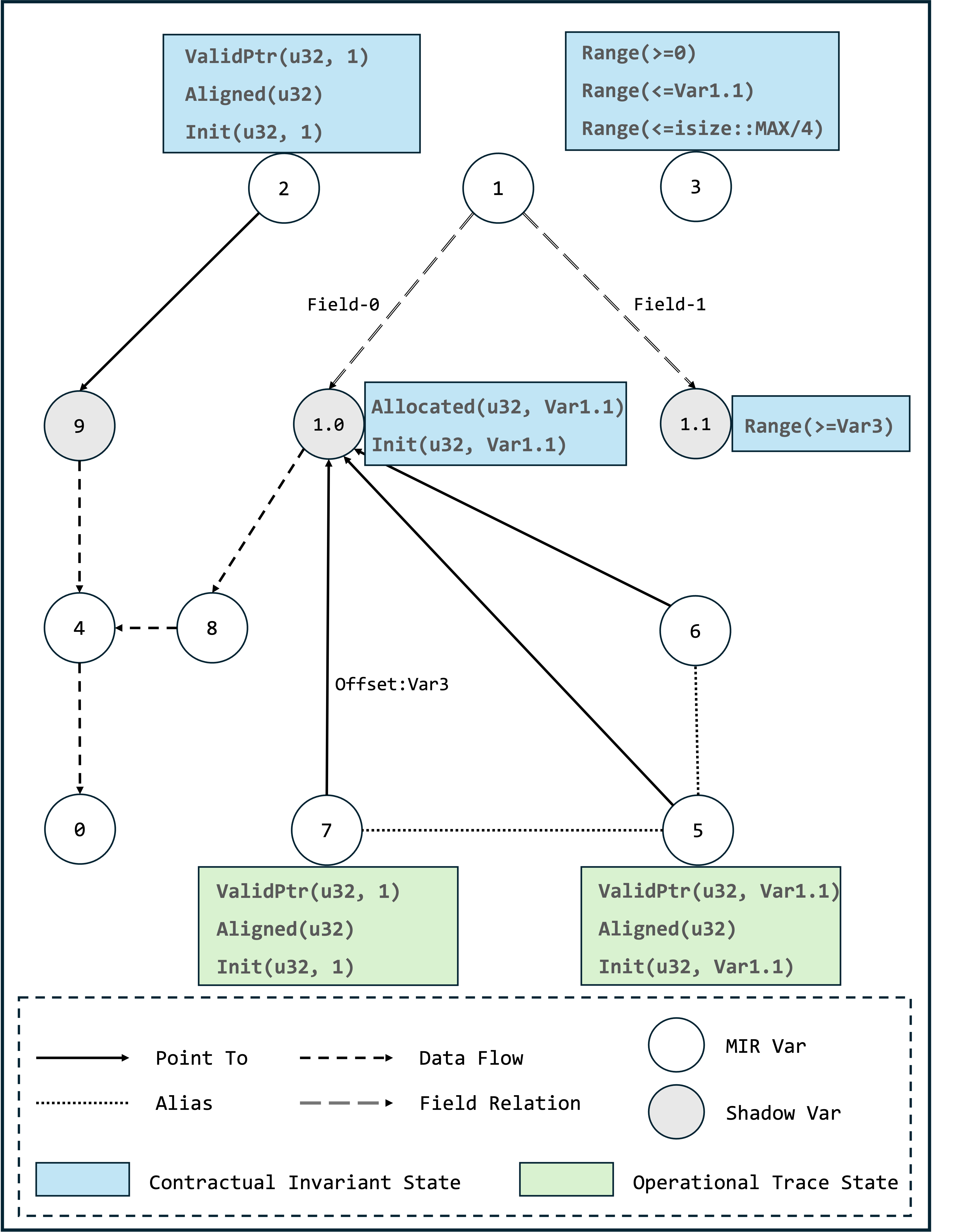
Safety Contract Checking
Whenever an unsafe call site is encountered, this step will be executed to detect the target contracts. In this case, we should verify the contracts of ptr::read and ptr::offset.
The verification engine validates safety contracts through state unification between OTS and CIS. For example, consider the ptr::offset's callsite and signature:
#![allow(unused)]
fn main() {
// callsite:
_7 = std::ptr::const_ptr::<impl *const u32>::offset(copy _5, copy _3)

// signature:
pub const unsafe fn offset(self, count: isize) -> *const T

// transition of arguments names to MIR variables
self => Var5
count => Var3
}
Subsequently, we verify ptr::offset's two contracts based on the states of Var5 and Var3.
(1) InBounded (self, u32, count) => InBounded (Var5, u32, Var3)
- Var5 has OTS:
ValidPtr(u32, var1.1).ValidPtris a composite SP, which impliesInBounded(u32, var1.1).
   Var5: ValidPtr(u32, var1.1)
=> Var5: InBounded(u32, var1.1)
=> Var5: InBounded(u32, var1.1) + Var1.1 >= Var3
=> InBounded (Var5, u32, Var3)
=> Pass!
(2) ValidNum (count * size_of(T) <= isize::MAX) => ValidNum (Var3 * size_of(u32) <= isize::MAX)
- Var3 has the CIS:
Range(<=isize::MAX/4).
   Var3 <=isize::MAX/4
=> Var3 * size_of(u32) <= isize::MAX
=> ValidNum (Var3 * size_of(u32) <= isize::MAX)
=> Pass!
Vulnerable Path Analysis
Before reaching the unsafe call site, we need to track the variable states of its arguments. They may be affected by other variables along the path. We refer to such paths as vulnerable paths.
If the analysis target is a method taking self as an argument, its vulnerable path comprises two components:
- Inter-procedural paths combining constructors and mutable methods. This can be referred to in the Adt Analyzer section of the above architecture diagram. The algorithm for generating mutable method sequence is still under development.
- Intra-procedural paths from the function's entry point(s) to unsafe call sites within the method body.
If the analysis target is a function without a self parameter, only the latter is considered.
audit unsafe APIs' SP in core and alloc
Specifically, we currently integrate a set of SP labels analysis for core and alloc crate of the Rust standard library.
- Create a new
helloworldproject. - Navigate to the
helloworldproject directory and run:
cargo rapx -stdsp -- -Zbuild-std --target x86_64-unknown-linux-gnu > /your/output/log/path/result.log 2>&1
Replace /your/output/log/path with your desired output directory. This will output APIs where the caller and callee have different SPs.
Demonstration Framework: Align SP in MIR
Analysis Foundation:
-
The MIR statement types are finite and well-defined
-
Pointer misalignment originates from a limited set of operations
These characteristics enable comprehensive modeling of all defect patterns in MIR. Specifically, scenarios causing pointer misalignment are enumerable and fall into three categories:
-
Casting: Intrinsic operations changing pointer types
-
Pointer Arithmetic: Pointer arithmetic altering address alignment
-
Untrusted origins: Untrusted origins without alignment validation
These three mechanisms represent fundamental sources of misalignment. We systematically address each root cause through dedicated rules in sections 5.2.1-5.2.3. Additionally, we model secondary propagation scenarios where unaligned pointers contaminate other pointers through copies or derived operations. These propagation pathways are analyzed in section 5.2.4.
We will examine each category through concrete examples and formal rules. All the rules operate on following Align lattice:
L = {Top, Aligned, Unaligned, Unknown}
It has partial ordering:
        Top
      /     \
  Aligned  Unaligned
      \     /
      Unknown
Alignment = 2^k (k ∈ ℕ) represents concrete alignment values as powers of two.
5.2.1 Casting
Type conversion operations are the main source of memory alignment issues. In Rust, when a pointer is forcibly converted from a low-alignment type to a high-alignment type, if the original address does not meet the alignment requirements of the new type, undefined behavior will occur. The following example demonstrates this dangerous conversion:
#![allow(unused)]
fn main() {
fn type_cast_ub() {
    let data = [0u8; 5]; // u8 => one byte alignment
    let ptr = data.as_ptr();
    let unaligned_ptr = ptr as *const u32;
    unsafe {
        // 💥 UB here! Ptr is not 4-byte aligned
        let _value = *unaligned_ptr;
    }
}

Simple MIR of type_cast_ub:
bb 0 {
    Assign((_1, [const 0_u8; 5]))
    Assign((_4, &_1))
    Assign((_3, move _4 as &[u8] (PointerCoercion(Unsize, Implicit))))
    _2 = core::slice::<impl [u8]>::as_ptr(move _3) -> [return: bb1, unwind continue]
}
bb 1 {
    Assign((_6, copy _2))
    Assign((_5, move _6 as *const u32 (PtrToPtr)))
    Assign((_7, copy (*_5))) @ _7=copy (*_5)
    Assign((_0, const ())) @ _0=const ()
    return
}
}
In this example, the memory object (data) is assigned fixed types and one-byte alignment when it is created. Pointer conversion causes the pointer type to be four-byte alignment, inconsistent with the memory object type.
Rust supports two distinct cast operations in MIR statements: PtrToPtr and Transmute cast. To address potential alignment violations, we've established dedicated defect detection rules (Rule1 and Rule2) for these operations:
Rule1 (Casting):
    Γ ⊢ statement: left_ptr = Cast(cast_kind, right_ptr, τ_dst),
        cast_kind ∈ {PtrToPtr, Transmute},
        τ_src = right_var.point_to.type,
        A_src = align_of(τ_src),
        A_dst = align_of(τ_dst)
    ───────────────────────────────────────────────────────────
    Γ ⊢ left_var.point_to = right_var.point_to
        ▸ Tag(left_ptr, Unaligned) if A_src < A_dst
        ▸ Tag(left_ptr, Aligned) otherwise
For Rule1 (Casting), when a pointer (right_ptr) undergoes PtrToPtr or Transmute casting to a destination type τ_dst, the system first retrieves the source type τ_src and its alignment A_src from the pointer's point-to metadata (constructed from dominated graph discussed in section 3). It compares A_src with A_dst. The resulting pointer (left_ptr) inherits the original memory object but is tagged UNALIGNED if A_dst > A_src, indicating stricter alignment requirements are potentially violated; otherwise, it receives the ALIGNED tag.
5.2.2 Pointer Arithmetic
Pointer arithmetic operations pose subtle alignment risks when offsets aren't multiples of the target type's alignment. The following example shows how byte addition can create misaligned pointers:
#![allow(unused)]
fn main() {
fn pointer_arithmetic_ub(value: usize) {
    let data = [0u32; 3];
    let base_ptr = data.as_ptr();
    // Sound pointer arithmetic
    // if value % 4 == 0 {
    //     let misaligned_ptr = unsafe { base_ptr.byte_add(value) };
    // }

    // Unsound pointer arithmetic
    // Unsafe func ptr::byte_add doesn't have the alignment reuqirement.
    let misaligned_ptr = unsafe { base_ptr.byte_add(value) };
    unsafe {
        let _value = *misaligned_ptr; // 💥 UB
    }
}

Simple MIR of pointer_arithmetic_ub:
bb 0 {
    Assign((_2, [const 0_u32; 3]))
    Assign((_5, &_2)) @ _5=&_2
    Assign((_4, move _5 as &[u32] (PointerCoercion(Unsize, Implicit))))
    _3 = core::slice::<impl [u32]>::as_ptr(move _4) -> [return: bb1, unwind continue]
}
bb 1 {
    Assign((_7, copy _3))
    Assign((_8, copy _1))
    _6 = std::ptr::const_ptr::<impl *const u32>::byte_add(move _7, move _8) -> [return: bb2, unwind continue]
}
bb 2 {
    Assign((_9, copy (*_6))) @ _9=copy (*_6)
    Assign((_0, const ())) @ _0=const ()
    return
}
}
In this case, the memory object (data) maintains fixed 4-byte alignment. Pointer arithmetic modifies the offset by byte but not checks whether the offset value is a multiple of 4, creating potential mismatches.
In MIR, this type of operation exists in the form of a function call. So we have corresponding rule as:
Rule2 (P-Arith):
    Γ ⊢ statement: left_ptr = Call(func, [base_ptr, offset_val]),
        func ∈ {ptr::byte_add, ptr::byte_offset, ptr::byte_sub,
            ptr::wrapping_byte_add, ptr::wrapping_byte_offset,
            ptr::wrapping_byte_sub},
        obj_τ = base_ptr.point_to.type,
        base_ptr_offset = base_ptr.offset,
        Δ = abstract_eval(offset_val),
        offset' = base_ptr_offset + Δ
    ───────────────────────────────────────────────────────────
    Γ ⊢ left_ptr.point_to = base_ptr.point_to,
        left_ptr.offset = offset'
        ▸ Tag(left_ptr, Unaligned) if offset' % align_of(obj_τ) ≠ 0
        ▸ Tag(left_ptr, Aligned) otherwise
For Rule2 (P-Arith), during pointer arithmetic calls (e.g., ptr::byte_add), the rule computes the new offset (offset') by abstractly evaluating the offset value (Δ) and adding it to the base pointer's existing offset. The base_ptr.offset is an offset based on the initial address of the object. A specific example can be found in dominated graph's Var_7 in the graph of section 3.2.3. The resulting pointer (left_ptr) references the same memory object but is tagged UNALIGNED if offset' is not divisible by the object type's alignment (i.e., offset' % align_of(obj_τ) ≠ 0), signaling misalignment; otherwise, it is tagged ALIGNED.
Direct numerical manipulation of pointers (e.g., p as usize + offset) also creates alignment risks through a two-step process:
-
PtrToInt: Casting a pointer to an integer strips alignment metadata while preserving provenance -
IntToPtr: Converting the modified integer back to a pointer may violate destination type alignment
Rule3 (PtrToInt):
    Γ ⊢ statement: int_val = Cast(cast_kind, ptr, τ),
        cast_kind = PointerExposeProvenance,
        τ_src = ptr.point_to.type,
        existing_byte_offset = ptr.accumulated_offset,
    ───────────────────────────────────────────────────────────
    Γ ⊢ int_val.provenance = (τ_src, existing_byte_offset)
When encountering a PointerExposeProvenance cast (pointer→integer conversion), the rule records the object's source type (τ_src) and accumulated byte offset (existing_byte_offset). These are stored as provenance metadata attached to the integer value.
Following this cast, abstract interpretation tracks potential arithmetic modifications to the integer value (stored at int_val.changed_value), modeling numerical changes.
Rule4 (IntToPtr):
    Γ ⊢ statement: new_ptr = Cast(cast_kind, int_val, τ_dst),
        cast_kind = PointerWithExposedProvenance,
        (τ_src, existing_byte_offset) = int_val.provenance,
        Δ = abstract_eval(int_val.changed_value),
        new_byte_offset = Δ + existing_byte_offset
        A_src = align_of(τ_src),
        A_dst = align_of(τ_dst),
    ───────────────────────────────────────────────────────────
    Γ ⊢ new_ptr.offset = new_byte_offset
        ▸ Tag(new_ptr, Aligned) if ( new_byte_offset % A_src == 0
                                    ∧ A_src >= A_dst )
        ▸ Tag(new_ptr, Unaligned) otherwise
When converting an integer back to a pointer via PointerWithExposedProvenance cast, the rule:
-
Recovers the original source type (
τ_src) andexisting_byte_offsetfrom provenance metadata -
Computes the new offset change (Δ) via abstract interpretation
-
Derives the final byte offset:
new_byte_offset=existing_byte_offset+ Δ -
Compares alignments between
A_srcandA_dst
The pointer is tagged Aligned only if the final offset satisfies original alignment and destination alignment is weaker.
5.2.3 Untrusted Origins
Pointers from external sources requires explicit alignment validation before use. The example demonstrates direct dereferencing of unverified pointers:
#![allow(unused)]
fn main() {
// Unsafe function accepting untrusted pointer
fn untrusted_sources_ub(ptr: *const u32) -> u32 {
    // 💥 Risk with unaligned external pointer
    unsafe { *ptr }
}

Simple MIR of untrusted_sources_ub
bb 0 {
    Assign((_2, copy _1 as *const () (PtrToPtr)))
    Assign((_0, copy (*_1))) @ _0=copy (*_1)
    return
}
}
Here, the memory object's alignment is unknown since it originates outside the audit boundary. Direct usage without verification violates Rust's safety contracts.
Rule5 (U-Source):
    Γ ⊢ context, statement: left_var = (Copy(ext_ptr) | Move(ext_ptr))
        ext_ptr ∈ {FFI, unvalidated_input}
        ¬∃ alignment_validation(context)
    ───────────────────────────────────────────────────────────
    Γ ⊢ object_var = new shadow_var@(unknown),
        left_var.point_to = object_var,
        ▸ Tag(left_var, Unknown)
        ▸ Until explicit validation or pointing to new object
For Rule4 (U-Source), pointers from untrusted origins (FFI/unvalidated input) trigger the creation of a new shadow memory object with unknown alignment. The pointer (left_var) references this object and is immediately tagged UNKNOWN due to absence of prior alignment validation. This tag persists until either explicit runtime validation occurs or the pointer is reassigned to a known object.
5.2.4 Unalignment Propagation
Unaligned pointer vulnerabilities originate from the above three core operations. Once created, these unaligned states can be propagated through: (i) Direct pointer copies/moves (Rule5), and (ii) Pointer arithmetic that inherits existing unaligned/unknown states (Rule6).
Rule6 (Propagation1):
    Γ ⊢ statement: left_ptr = (Copy(right_ptr) | Move(right_ptr)),
    ───────────────────────────────────────────────────────────
    Γ ⊢ left_ptr.point_to = right_ptr.point_to
        ▸ Tag(left_ptr, right_ptr.tag)
When a pointer (right_ptr) is copied or moved to a new variable (left_ptr), the system transfers both the memory object reference (left_ptr.point_to = right_ptr.point_to) and the alignment tag (left_ptr.tag = right_ptr.tag) directly. This preserves the original alignment state (Aligned/Unaligned/Unknown) during assignment operations without modification.
Rule7 (Propagation2):
    Γ ⊢ statement: left_ptr = Call(func, [ptr, new_offset]),
        func ∈ {ptr::add, ptr::offset, ptr::sub,
            ptr::wrapping_add, ptr::wrapping_offset,
            ptr::wrapping_sub},
        existing_ptr_offset = ptr.accumulated_offset,
        Δ = abstract_eval(new_offset),
        offset' = existing_ptr_offset + Δ,
        ptr.tag ∈ {Unaligned, Unknown}
    ───────────────────────────────────────────────────────────
    Γ ⊢ left_ptr.point_to = base_ptr.point_to,
        left_ptr.accumulated_offset = offset'
        ▸ Tag(left_ptr, ptr.tag)
For other pointer arithmetic calls (e.g., ptr::add/ptr::wrapping_add), when the input pointer (ptr) is already tagged as UNALIGNED or UNKNOWN, the resulting pointer (left_ptr) inherits both the original memory object and the input pointer's alignment tag (left_ptr.tag = ptr.tag), regardless of offset changes.
5.3 False Positives Handling
While inherent over-approximation in abstract interpretation means some false alarms remain unavoidable, the path-sensitive MOP (Meet Over all Paths) approach significantly reduces false positives by reducing the number of state merges in control flow. Currently, the UB reports still require manual review.
6.4.5 Verification for Vec in std-lib
6.1 Introduction
We select vec::into_raw_parts_with_alloc as our primary example, demonstrating how RAPx systematically verifies that internal ptr::read operations remain UB-free throughout the vector's lifecycle.
There are three categories to be checked in our audit units:
-
Construction boundaries: Safe/unsafe constructors that establish initial invariants
-
Methods boundaries: Methods modifying vector state (push, pop, set_len, etc.)
-
Unsafe Call Site: Target method with unsafe callee to be verified (e.g. into_raw_parts_with_alloc)
6.2 Constructor Analysis
The verification of vec::into_raw_parts_with_alloc begins with comprehensive constructor analysis. RAPx will systematically examine all Vec constructors to establish baseline invariants that propagate through the vector's lifecycle.
Specifically, Vec includes the following constructors. RAPx then visits each constructor's body sequentially, using abstract interpretation to build the state of Vec fields (e.g., Init, Allocated, InBound states). RAPx employs the Tarjan algorithm to analyze paths within individual function bodies, performing Meet-Over-All-Paths (MOP) analysis at the conclusion of all paths. Interprocedural analysis follows this approach to analyze callees and extract results, with a maximum analysis depth of 10,000. The analysis of constructors primarily records type information, value flow, and memory allocation status (tracking allocator usage via dataflow). The results for Vec<T, A> constructors are summarized in the table below:
| Constructor | Field1: buf(RawVec<T, A>) | Field2: len(usize) |
|---|---|---|
| new_in(alloc: A) -> Vec<T, A> | value flow: alloc -> buf.inner.alloc | 0 |
| with_capacity_in(capacity: usize, alloc: A) -> Vec<T, A> | value flow: alloc -> buf.inner.alloc \ Allocated(capacity) | 0 |
| try_with_capacity_in(capacity: usize,alloc: A) -> Result<Vec<T, A>, TryReserveError> | value flow: alloc -> buf.inner.alloc \ Allocated(capacity) | 0 |
| from_raw_parts_in(ptr: *mut T, length: usize, capacity: usize, alloc: A) -> Vec<T, A> | value flow: alloc -> buf.inner.alloc \ Allocated(capacity) | length |
| from_parts_in(ptr: NonNull | value flow: alloc -> buf.inner.alloc \ Allocated(capacity) | length |
In the verification for vec::into_raw_parts_with_alloc, only the alloc field is used with unsafe operations, so the memory allocation results from constructor analysis are not fully exercised here (but they can find broader application in other Vec APIs).
Before proceeding to the next step, the field states from all constructors are merged to establish comprehensive initial states.
6.3 Methods Sequence Analysis
Following constructor analysis, we examine how method sequences affect vector state transitions - a property we term Struct Soundness. RAPx analyzes every method with mutable self in Vec's implementation, generating a sequence of modified fields for each method. Before verifying the target function, RAPx combines the fields used by the target function with these modification sequences to derive relevant method sequences, then checks their bodies.
For example, vec::into_raw_parts_with_alloc utilizes the field buf.inner.alloc. The analysis must identify all methods that potentially modify the field and evaluate whether soundness is maintained when into_raw_parts_with_alloc is called after any sequence of preceding operations. By tracing possible call sequences leading to into_raw_parts_with_alloc, RAPx ensures that all intermediate states maintain the necessary invariants for safe memory access.
TODO: The sequence generation algorithm is still under heavy development and testing.
6.4 Verifying ptr::read Safety in vec::into_raw_parts_with_alloc
The final verification step focuses directly on the ptr::read operations within into_raw_parts_with_alloc.
Key basic blocks in MIR:
bb 0 {
CleanUp: false
    _2 = std::mem::ManuallyDrop::<std::vec::Vec<T, A>>::new(move _1) -> [return: bb1, unwind continue] @ Call: FnDid: 2129
}
...
bb 7 {
CleanUp: false
    Assign((_16, &_2)) @ _16=&_2 @ Ref
    _15 = <std::mem::ManuallyDrop<std::vec::Vec<T, A>> as std::ops::Deref>::deref(move _16) -> [return: bb8, unwind continue] @ Call: FnDid: 3878
}
bb 8 {
CleanUp: false
    _14 = std::vec::Vec::<T, A>::allocator(copy _15) -> [return: bb9, unwind continue] @ Call: FnDid: 8138
}
bb 9 {
CleanUp: false
    Assign((_13, &raw const (*_14))) @ _13=&raw const (*_14) @ RawPtr
    _12 = std::ptr::read::<A>(move _13) -> [return: bb10, unwind continue] @ Call: FnDid: 26429
}
...
Based on the MIR, we can construct the dominated graph as described in Chapter 3. The analysis shows:
-
In bb0, the Vec is wrapped in ManuallyDrop
-
In bb7,
_16is the reference of_2and dereferences to access the inner Vec (_15) -
In bb8, the allocator is obtained via
Vec::allocator()on_15, producing reference _14 -
In bb9,
_13becomes a raw pointer to the allocator, which is then read viaptr::read
Contract Verification:
Typed: In our tag system, Typed implies Init, requiring Init verification. However, since Rust follows RAII principles, the alloc field is guaranteed to be initialized with the correct type in non-MaybeUninit scenarios (even when using transmute, this property must hold). Thus, the allocator stored in Vec maintains correct typing throughout, satisfying the Typed contract.
Align: The pointer type *const A matches the object type A, ensuring proper alignment per the Align contract.
ValidPtr: For non-ZST scenarios, the alloc is guaranteed to be properly initialized regardless of which constructor was used. The pointer is therefore non-null and dereferenceable, satisfying the ValidPtr contract.