Chapter 5.3. API-Dependency Graph
Overview
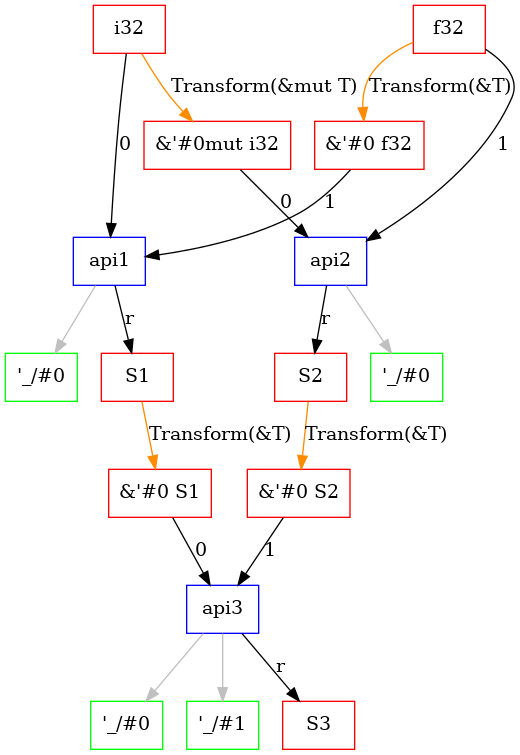
The API Dependency Graph is a directed graph structure that models dependencies among APIs, types, and generic parameters by traversing the APIs within a Rust library or crate. It contains three types of nodes: API, type and generic parameter. And it contains four types of edges : Arg(usize, recording the location in API parameter), Ret, Generic and Transform(TransformKind, recording the relation between types, such as T and &T, &mut T). Now this module is still under development and generic is not supported.
Use the following example to demonstrate this graph structure.
#![allow(unused)]
fn main() {
pub struct S1 {
    pub a: i32,
    pub b: f32,
}

pub struct S2 {
    pub a: i32,
    pub b: f32,
}

pub struct S3 {
    pub a: i32,
    pub b: f32,
}

pub fn api1(arg1: i32, arg2: &f32) -> S1 {
    S1 { a: arg1, b: *arg2 }
}
pub fn api2(arg1: &mut i32, arg2: f32) -> S2{
    S2 { a: *arg1, b: arg2 }
}

pub fn api3(arg1: &S1, arg2: &S2) -> S3{
    S3 { a: arg1.a, b: arg2.b }
}
}
By scanning the code above, we generate an API Dependency Graph like this:
Quick Usage Guide
If your project doesn't have a rust-toolchain.toml, you need to create such a file contains the following content:
[toolchain]
# The default version of the rustc compiler
channel = "nightly"
components = ["rustc-dev", "rust-src", "llvm-tools-preview"]
We use this feature for generating fuzz targets about library APIs. You can use this feature with the following command(Make sure you are in a cargo project):
cargo rapx analyze adg
This command will analyse your project and gengerate a .dot file in the current directory, which contains the API dependency graph information, and also generate a new project in the parent directory. The new project is a fuzz target that contains APIs in your project.You can visualize this graph by using one of the following commands.
dot -Tsvg your_crate_name.dot -o api_graph.svg
dot -Tpng your_crate_name.dot -o api_graph.png
To utilize the analysis results, you can use the module as follows:
#![allow(unused)]
fn main() {
use analysis::api_dependency::{ApiDependencyAnalyzer, Config}; // Import the module
let config = Config::default();
let mut api_graph = ApiDependencyAnalyzer::new(tcx, config);
api_graph.run();
}
The above codes can generate an API dependency graph based on your crate.
Graph APIs
The ApiDepGraph struct provides several APIs for interacting with the dependency graph. Below are the key methods. Before using these APIs, you need to import relevent module:
#![allow(unused)]
fn main() {
use analysis::api_dependency::graph; // Import the module
}
statistics
Returns statistics about the graph, including counts of API nodes, type nodes, generic parameter nodes, and edges.
#![allow(unused)]
fn main() {
// Here is the definition of Statistics
pub struct Statistics {
    pub num_api: usize,
    pub num_generic_api: usize,
    pub type_count: usize,
    pub edge_cnt: usize,
}
pub fn statistics(&self) -> Statistics
}
inner_graph
Returns reference of the graph data.
#![allow(unused)]
fn main() {
pub fn inner_graph(&self) -> &InnerGraph<'tcx> // InnerGraph is Graph<DepNode<'tcx>, DepEdge>
}
get_or_create_index
Retrieves or creates a node index for a given DepNode. If the node doesn't exist in the graph, it will be added.
#![allow(unused)]
fn main() {
pub fn get_or_create_index(&mut self, node: DepNode<'tcx>) -> NodeIndex
}
get_index
Given a DepNode, returns Option<NodeIndex>, since it may not exist in the graph.
#![allow(unused)]
fn main() {
pub fn get_index(&self, node: DepNode<'tcx>) -> Option<NodeIndex>
}
The feature is based on our RuMono paper, which was published in TOSEM.
@article{zhangrumono,
  title={RuMono: Fuzz Driver Synthesis for Rust Generic APIs},
  author={Zhang, Yehong and Wu, Jun and Xu, Hui},
  journal={ACM Transactions on Software Engineering and Methodology},
  publisher={ACM New York, NY}
}